


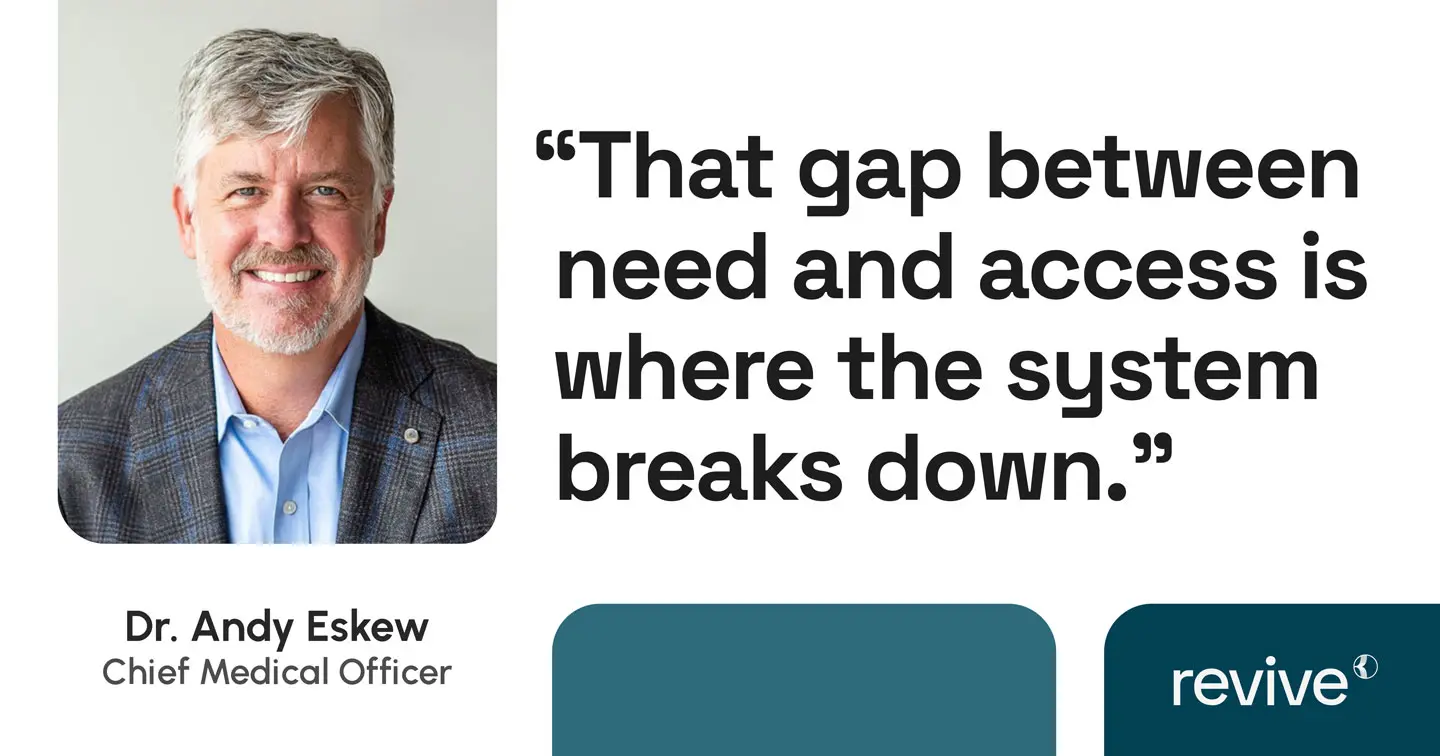
By Dr. Andy Eskew, MD, MBA
Chief Medical Officer, Revive Health
I still practice medicine. I spend time in hospitals, in operating rooms, and in emergency settings. I see patients when things are urgent and complex, and I see what happens when care does not happen soon enough.
From that vantage point, it becomes clear that the most significant problem in healthcare today is not quality or capability. It is access. Too many people simply cannot get evaluated when they need to be.
That gap between need and access is where the system breaks down.
Access Determines Everything That Follows
Healthcare discussions often focus on outcomes, cost, and quality. Those are important conversations, but they assume something fundamental that often is not true. They assume the patient can actually enter the system.
In reality, many people cannot get an appointment when a problem starts. They wait days or weeks. They delay care. Or they end up in settings that were never designed to be the first stop, like emergency rooms or urgent care centers.
That is not because people are making poor decisions. It is because access has failed them.
When patients cannot be evaluated promptly, minor problems become major ones. Clinical decisions get delayed. Costs increase. Outcomes worsen. All of that starts with access.
What Virtual Care Actually Solves
Virtual care is often discussed as a replacement for in-person visits. That framing misses the point.
Not every medical problem can be treated virtually. Anyone who practices medicine knows that. But every medical problem can be assessed virtually.
Assessment is the most important step in care. It is where a clinician listens, asks questions, reviews symptoms, and determines what needs to happen next. Without assessment, everything downstream becomes guesswork.
Virtual care is uniquely suited to solve this part of the problem. It removes the barriers of time, geography, and scheduling and allows people to be evaluated quickly by a licensed clinician.
That alone changes the trajectory of care.
Assessment Is the Front Door to the Right Care
In my own clinical experience, I have seen how powerful timely assessment can be. There were many situations where my physical presence was not required, but my judgment was. Reviewing information, understanding the context, and helping determine next steps made all the difference.
That is what assessment does. It creates clarity.
Sometimes the right outcome is reassurance and guidance. Sometimes it is an in-person visit. Sometimes it is escalation. But in every case, the patient benefits from knowing what to do next and why.
Without that clarity, people default to delay or to the most expensive option available.
Speed Changes Behavior
One of the most overlooked aspects of access is how quickly someone can be seen. Being evaluated days later is not the same as being evaluated when symptoms begin.
When people know they can reach a clinician quickly, they are more likely to seek care early. That leads to better decision-making and better outcomes.
I have never seen traditional healthcare settings consistently offer that level of responsiveness. Virtual assessment makes it possible, and it sets a new expectation for what access should look like.
Virtual Assessment Is Not the End of Care
It is important to be clear about what virtual care is and is not. Virtual assessment does not replace in-person medicine. It enables it. It ensures that people arrive at the right place, at the right time, for the right reason.
When access works, the system works better for everyone. Clinicians spend their time where they are most needed. Patients feel guided instead of lost. Resources are used more appropriately.
That is the role virtual care should play. Not as a niche convenience, but as the front door to the healthcare system.
Fix Access First
Healthcare does not need more complexity. It needs better access.
When people can be assessed quickly, listened to carefully, and directed appropriately, everything else becomes easier. Virtual care makes that possible at scale.
Not every medical problem can be treated virtually. But every medical problem deserves timely assessment.
That is where fixing healthcare begins.