


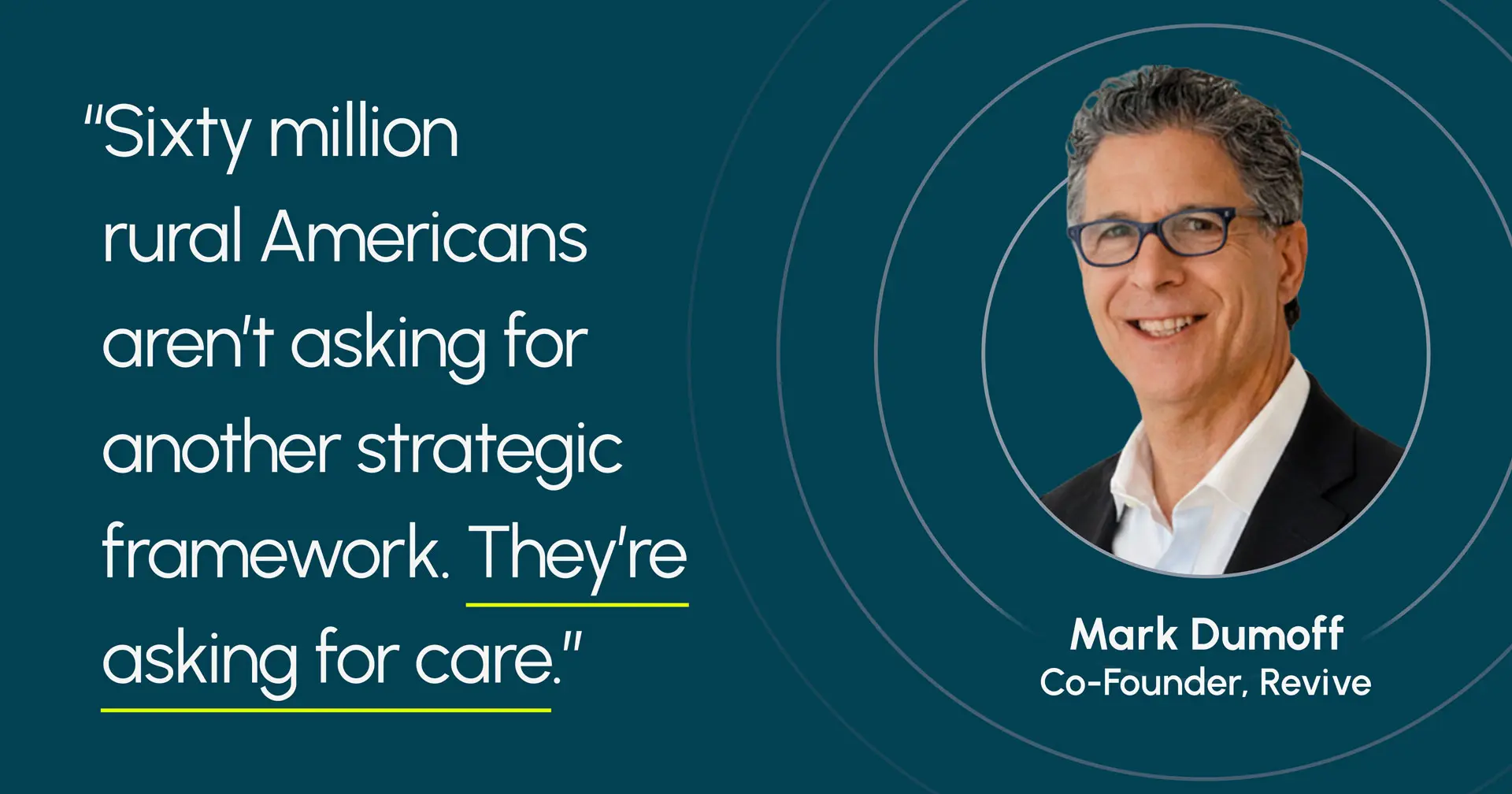
Mark Dumoff
Co-Founder, Revive
Rural healthcare organizations are navigating increasing pressure to improve access, strengthen sustainability, support clinical teams, and deliver measurable progress across underserved communities.
Too often, rural healthcare conversations focus on long-term frameworks while communities continue struggling with immediate gaps in access, continuity, and coordination. As I shared in my recent MedCity News article, “Sixty million ruralAmericans aren’t asking for another strategic framework. They’re asking for care — accessible, affordable, and delivered with dignity.” Delivering that level of care consistently across rural communities requires models that can operate effectively within the day-to-day realities that health systems and providers manage.
Many health systems already understand the structural issues affecting rural care delivery, but the real challenge is execution. How do organizations build care models that can operate consistently across large geographic regions while supporting both patients and providers over time?
That question is shaping conversations around rural health transformation across rural America as health systems and state agencies work to stabilize services in geographically dispersed regions.
Fragmentation Continues to Undermine Rural CareDelivery
Rural populations are often navigating disconnected systems where primary care, behavioral health, pharmacy support, chronic condition management, and specialty services operate independently from one another.
Even when services are technically available, patients may still struggle to access care consistently. Missed follow-ups, limited coordination, distance, and workforce constraints can interrupt continuity for people managing complex health needs.
To address these obstacles, many rural healthcare organizations are reevaluating how care coordination and virtual services integrate in existing systems to provide patients with timelier, connected support.
Virtual Care Expands Access, but Integration DrivesImpact
Rural healthcare delivery requires models designed for distributed populations and evolving workforce realities.
Programs originally built for urban systems do not always translate effectively across regions where provider capacity, broadband access, geography, and local resources shape day-to-day care delivery. As noted in the MedCity News article,“21 million Americans still lack broadband access,” limiting how some communities access healthcare services and virtual support.
Virtual care can help extend reach, particularly in communities where providers and ongoing support are difficult to access. But access alone does not create continuity.
Rural transformation efforts are more effective when virtual services are integrated into broader care coordination models that help patients stay connected to care across providers and settings.
When virtual care operates as part of a connected delivery model rather than as a standalone solution, healthcare organizations are better positioned to support patients consistently across multiple care needs and settings.
Care Coordination Improves Continuity Across RuralCommunities
Care coordination plays an important role in helping rural healthcare organizations reduce fragmentation and improve continuity across distributed populations.
Patients managing multiple conditions often move between clinics, pharmacies, and local hospitals without clear coordination between providers. In rural communities, long distances and limited provider availability can make those gaps harder to navigate.
Integrated care coordination creates stronger connections between services by providing consistent care to patients.
At Revive, rural health transformation focuses on integratingclinical, behavioral, pharmacy, and navigation support into connected deliverymodels that can operate alongside existing healthcare systems rather thanadding fragmented care.
This type of coordination can help providers maintain greater visibility across the patient journey while giving patients more consistent support as they move through different levels of care. It also helps reduce avoidable disruptions that can lead to delayed treatment, unnecessary emergency visits, or disengagement from care altogether.
Implementation Requires Operational Models That CanScale
Healthcare organizations and state leaders are under growing pressure to demonstrate measurable improvements tied to access, continuity, sustainability, and long-term participation in care.
As rural transformation efforts move from planning into deployment, implementation is increasingly being evaluated based on how effectively programs function across real-world healthcare environments and whether they can support providers and patients consistently over time.
Implementation depends on whether programs can:
- Operate across wide geographic areas
- Coordinate services consistently
- Support local providers
- Reduce fragmentation
- Integrate into existing systems withoutadministrative burden
Connected care models are gaining traction because they help healthcare organizations create more reliable pathways through care while easing pressure on providers and care teams. When services are better aligned, patients are more likely to stay connected between visits, and care teams can respond earlier when needs change.
Supporting Rural Healthcare Through Connected Care
Rural healthcare transformation is becoming less about adding more disconnected programs and more about building systems that help care function together more effectively over time.
Organizations making meaningful progress are focusing on the full patient journey, from initial access and clinical support to medication needs and care navigation.
Connected care models can help strengthen continuity by improving how services communicate, how patients access support, and how providers maintain visibility across the patient journey.
For rural populations facing distance, provider access challenges, or complex health needs, continuity can help improve engagement and support more sustainable long-term care delivery.